Wednesday, June 30, 2010

Fun Fact of the Day 6/30

So, I was sitting around today when a special came on the National Geographic channel all about rats. Naturally, I watched it, and it was really awesome. So, in honor of our furry friends, I'll share a few facts about rats and why you should regard them not with revulsion, but with admiration.

Perhaps the most impressive aspect of these rodents, and one which very few people are aware of, is their remarkable intelligence. Many people can recall examples of experiments in which a rat or mouse was placed in a maze with some cheese at the end as a behavior test, but what few realize is just how smart rats are when it comes to these things. The experiment depicted in the special I saw today was a particularly telling example of this. The scientist (I can't remember his name, my apologies) placed rats in a maze with a cookie hidden in it. Along the way, several random objects were placed, such as plastic toys and the like. What was discovered by placing electrodes on the rat's brain during testing is that the rat actually constructs a mental movie of sorts of the path taken to the food, for future use. Then, in future tests with the same rat, the scientists would observe the rat pausing upon encountering the first landmark from before. Then, on the computer, the same pattern of neurons fired as when the rat followed the maze before, even though the animal was stationary. This thus showed that the rat was actually pausing to think about the direction to the food, and when it resumed movement, it reached the cookie much faster. So, rats actually have the ability to "record" memory very vividly for future use!

Then there is their rather fascinating physical adaptations as well. They can smell twice as good as a human, which is astounding for their size. Additionally, they can squeeze through tiny spaces because of their ribs, which are actually hinged at the spine to allow the animal to compact itself. This means that if a rat can fit it's head through a space, it can fit it's entire body through as well. They can tread water for three days straight without drowning, and can hold their breath for three minutes at a time, making them excellent in the water as well. Point being, rats are really quite awesome.

Tuesday, June 29, 2010

Fun fact of the Day 6/29


Not to worry, I still have a post in the making about all the squirrel stuff, you know, if you care. But while that's still going, I have yet another fun fact which may brighten your day (or just bore you).

Today's fun fact concerns a common misconception which many people have regarding the grouping of primates. Namely, people tend to mis- or over-use the term "monkey". For instance, after viewing "King Kong" (which is a kick-ass movie, by the way, particularly Peter Jackson's remake), you might feel inclined to say "aw, that poor monkey". To this I say nay nay. You see, King Kong is not at all a monkey for one simple reason: he doesn't have a tail. Instead, Kong is in fact an ape, not a monkey. But the tail's not the only difference, it's mainly a difference in classification.

Primates, a taxon which includes all simians, including lemurs, monkeys, apes, and humans, is broken down into two suborders:

-Strepsirrhini: the prosimians= lemurs and their kin, excluding tarsiers
-Haplorrhini: tarsiers, monkeys, and apes

It's the latter of those groups that contains the issue we're focusing on. Haplorrhini is thus broken down into old and new world monkeys. The old world group contains superfamily Homioidae, which is the ape family. Apes are thus separated from monkeys in classification, and are distinguished by the absence of tails, among other anatomical factors.

In short, apes are not monkeys, there is a defined difference.

Monday, June 28, 2010

Fun Fact of the Day 6/28: Why You Are Nice

So, it's about time I started posting some interesting tidbits every day once again. I'll get the post all about the squirrel research I helped with up later, but for now, let's explore something at least related, shall we?

It's an aspect of animal behavior called altruism. Now, altruism is used colloquially to describe any act that is beneficial to others. You might call yourself an altruist if you give money to a homeless person, or donate to a charity. However, in biological terms, altruism has a specific definition, and is thus a specific behavioral phenomenon. Speaking in these terms, altruism is defined as an act which is beneficial to another individual or group of individuals, and is costly to the individual completing the act. Say, for example, that you jump in front of someone about to be stabbed, and you take the hit instead. The other person has directly benefited, and you have taken the cost upon yourself of having a knife thrust into you by some asshole. Even if you weren't stabbed, you still took the risk, and that's considered a cost. Now, several animals display behavior that can be classified as altruistic. In the case of the squirrels I help study, individuals will cry out in alarm when there is a sighted predator, giving away their position (and thus putting themselves at risk), and alerting others to the danger (thus benefiting them by giving them early warning of a threat).

But speaking in terms of evolution, there is an inherent problem with altruism at face value. Why would any animal have the programmed impulse to put itself at risk? In terms of natural selection, it's a conundrum, because (in theory) animals without the behavior would not put themselves at risk nearly as much, and would be more likely to reproduce and out-breed the altruists, leading to the population becoming more selfish over time and weeding out the altruists. Yet in populations like the Belding's ground squirrel meadow I spent the last 11 days in, this doesn't happen. So, the question for evolutionary biologists and ethologists was, why?

That question was a remarkable issue for biologists for years. Even Darwin lamented in "On The Origin" that species like the social insects (which are full of individuals blindly sacrificing themselves for the good of the colony without reproducing themselves at all) could be the death of his theory. The puzzle remained irritatingly unsolved until the 1960's, when a British biologist named W.D. Hamilton came along and offered the answer. In his 1964 paper "the genetical evolution of social behaviour", Hamilton proposed a model for how altruism had evolved, without breaking the rules of natural selection. It involved a mechanism called kin selection.

In order to understand kin selection, a brief discourse upon how it works must first be made. Now, you are filled with genes, composed of DNA. Duh. But an important part of how heredity works is understanding the principles which explain your genetic relationship with other people. For instance, if you have a brother or sister, you share the same parents. Thus, it is highly likely that you share a number of the same genes with your sibling. You might have the same color eyes, for example, or have similar facial structure. And similar principles also apply to your behavior. Humans are a bad example for this, because so much of our behavior is learned rather than genetically programmed, but bear with me. If your brother has a gene that makes him afraid of spiders (theoretically, of course), it is more likely that you will also have this gene. You might not actually have it, but the point is that (because he's your brother) you have the highest probability of sharing that gene because of your close relatedness to him. His cousin has a slightly lesser chance of sharing the gene, and a second cousin has an even more scant chance. When you get to friends (i.e., people unrelated to him at all), it's basically a crapshoot over whether they'll have that gene or not because they're not related to him. So, the point here is that if you have a gene (or set of genes) that code for a certain behavior in response to a certain stimulus, your relatives (depending upon how closely they are related to you) are likely to have it as well.

Now, lets come back to kin selection and dear Dr. Hamilton. Altruism, according to Hamilton's paper, can be explained using the phenomenon of relatedness outlined above. How? Well, it's really pretty simple. Natural selection favors individuals with a higher fitness. Fitness is the reproductive success of an animal. But more basically, an animal with high fitness is able to spread it's genes better or more often than an individual with low fitness. Usually, this is achieved by a particular animal being stronger or better adapted, and thus more likely to reproduce. But with altruism, natural selection can favor behavior negative to oneself if it promotes fitness indirectly. See, if you examine altruistic behavior in animals very closely, it almost always occurs among related individuals, and not distant relatives or unrelated individuals. The reason for this is that in order for altruism to be adaptive, it must promote an individual's fitness more than a non-altruistic individual. So, if an animal saves it's sibling, the chances are that it's sibling shares many of the genes that it does, and even if the altruistic animal dies as a result of it's act, most of it's genes will will be passed on by the closely related family member, including the genes for altruism.

The result is what is now called "Hamilton's rule", a mathematical model for altruistic behavior. It reads as follows:
rB > C

In which:
r= coefficient of relatedness (an arbitrary value describing how closely related the two individuals are
B= the net benefit to the recipient of the behavior
C= the net cost to the actor

Thus, in order for altruism to be adaptive, the above inequality must be true. So, that explains why you are compelled to be nice to your family: because they'll pass on your genes even if you take a knife for one of them.

Posts in the works

Not to worry, I've got several lengthy posts on things coming up, including a really long fun fact. I haven't forgotten about my blog and my nine readers ;)

Friday, June 25, 2010

I'm Back!

Yep, my dad and I got back from camping/staying in a cabin yesterday, so I figured posting on the blog is appropriate. I did study squirrels on the trip, for about 10 days. I'll make a full post on the research later, with pictures and everything. Additionally, I'll resume fun facts as well. You know, if anyone cares.

Tuesday, June 15, 2010

On Hiatus With Squirrels

Well, I've been since Sunday. My dad and I are camping up at Rock Creek Lodge, out of Bishop, and internet is understandably limited, when available at all. Not that it matters, I've scarcely had the time or need to use a computer at all. See, I spend the time up here helping study Belding's ground squirrels in a nearby meadow, with a team of graduate students and a professor from the University of Chicago. Today was my first full day of work, and I helped tag a number of squirrels and observe activity budget data (what the animal does at 10 second intervals). In short, alot of fun, more on it next week when I come home.

Friday, June 11, 2010

Fun Fact of the Day 6/11

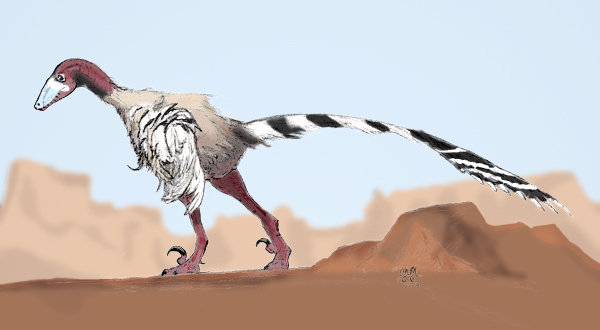
Well, because I had a Jurassic Park party last night, I'm really rather itching to share a fun fact about dinosaurs in some capacity. So, I've puzzled over just what exactly to write here, and then I settled on the idea of enlightening people to a fact which few people know about some dinosaurs. Now, it's commonly known, at least to a degree, that dinosaurs and birds share an evolutionary link. It's been the scientific consensus for a number of years now, and one can see the implications it's made in films like "Jurassic Park", in which the "Velociraptors" (actually deinonychus, see this fun fact for details) were fast, predatory pack hunters, moving more like killer ostriches than bipedal lizards. But in recent years since the film came out, another remarkable (if more superficial in an evolutionary context) bird-like feature of dinosaurs has become apparent: feathers. Now, before we discuss this feature in full, it is best to first explain it's restrictions within dinosaur classification. Feathers occur in many groups of dinosaurs, particularly on the smaller winged ones (duh) like Archeopteryx. But the group of dinosaurs that is believed to all have feathers is the group known as the Dromaeosaurids, or--if you prefer--the "raptors". This group includes Velociraptor and all of it's counterparts, such as Deinonychus and Dromaeosaurus. The first evidence that Dromaeosaurids had feathers was discovered in 1999, when impressions of feathers were found in the rock surrounding a well-preserved Sinorthosaurus fossil in China. Since then, similar evidence has been found for other members of the family, such as velociraptor, described fully in this paper. So, the scaly monsters that invade the kitchen in Jurassic Park can, since the turn of the century at least, be seen as looking more like killer birds. Personally, I think they look even more awesome that way =)

Thursday, June 10, 2010

Fun (or perhaps disturbing)Fact of the Day 6/10

So, the reader submission thing didn't really work, but that's fine, it's to be expected, after all. Instead, I will regale you with one of the decidedly less fun facts that I know, particularly if you're male. It concerns small catfish of the amazon in the Trichomycteridae family, collectively known as Candiru. Now, alot of myth surrounds the rather nasty parasitic habits of this fish, but much of it is simply hype. What is true is that there is at least one documented case of one of these little fish entering and affixing to the walls of a man's urethra. Yep, that little thing swam right up into his penis and spread it's spines...ouch. It had to be surgically removed. But males will be relieved to know that the supposed attraction of these fish to urine is in fact not true, as is the myth that they can swim up urine streams (yuck...). Instead, these little guys root about for food in the slightly acidic mud at the bottom of still parts of the Amazon, and tend to avoid humans as a natural source of parasitic attachment. Still, it does make one shudder just a wee bit, if you'll pardon the pun.

Fun Facts: Readers Choice (you know, if you want)

Urgle! I forgot to post a fun fact today! No matter, I'll make it up to all nine of you. I'll do a double fun fact tomorrow, reader-survey style! What animal do you want a fun fact about tomorrow afternoon? I'll pick two, and then away we'll go.

Tuesday, June 8, 2010

Fun Fact of the Day 6/8: Stream of Consciousness

So, I feel like, instead of one fully developed fact, I'll simply vomit a stream of little tidbits, sound good?
  • The largest overall snake in the world is the Anaconda (Eunectes murinus), which can reach lengths of around 25 feet and weights of 550 pounds
  • Crocodilians (which include, crocodiles, alligators, caimans, and gharials) are well-known for their bone-crushing bites, but it also little known that their jaws conversely are very weak when opening, and can be held shut with a good grip.
  • Walruses use their tusks for both sparring amongst themselves and to anchor themselves to the seabed when feeding in the mud for clams, which they locate with their sensitive lips and whiskers
  • Unlike most bats, fruit bats do not use echolacation, but instead have enormous eyes for seeing in the dark. The Flying Fox of australia is the largest bat in the world, and is considered a fruit bat.
  • Both sharks and platypuses share the same sixth sense: the ability to detect electrical impulses. Platypuses have receptors on their leathery bill for this sense, just as sharks have on their snouts
  • The largest eyes in the world belong to Mesonychoteuthis hamiltoni, or the "colossal squid" of antarctica, which can be nearly 2 feet across
  • Charles Darwin actually was initially very aloof about his finches, as he forgot to write down what island each of them were from. He had to use another naturalist's notes to establish where each species had come from.
  • sharks have been around in the fossil record for 400 million years
  • You are never (statistically) farther than 8 feet from a spider
  • The tiger shark is called the "garbage can of the sea" because of it's propensity to eat bizarre things. Among the objects purported to have been found in these animals stomach are: a dog, license plates, a roll of tar paper, nails, part of a suit of armor, handbags, linoleum, and even parts of people
  • Hippos cannot swim, they can only walk along the bottom. They also only spend the day in the water, and come out at night to wander distances as far as 6 miles to graze
  • Elephants eat four meals per day: three are the same time as our breakfast, lunch, and dinner, and the last is at around four o'clock in the morning
  • Peregrine falcons can enter a dive and reach speeds of over 200 miles per hour, opening their wings to hit targets (usually pigeons or other birds) and pulling a g-force of around 10 in the process. Needless to say, at this speed, the falcon's extended talons often rip the unlucky target clean in half
So, good?

Monday, June 7, 2010

Crododilian Columbus Counterparts Cruising on Currents

The saltwater crocodile, also known as the Indopacific and Estuarine crocodile (and colloquially called the "salty" by some Australians) is an animal with an impressive range, spreading from much of Australia to the southern parts of Indonesia. But one question that has continually puzzled scientists about this animal is how it travels within this range. Namely, the question is: how do saltwater crocodiles travel over large stretches of open ocean? This may sound easy, but the animals are actually poor long-distance swimmers, negating their ability to simply hop in the ocean and, you know, go. They're not Michael Phelps. But a new study published this week has finally revealed how the scaly travelers overcome this issue: they use ocean currents. Like sailing ships with wind, it was discovered using acoustic tagging that the animals use ocean currents to carefully ride their way to distant locations, whether they're on the same continent or not. This is facilitated by the crocodiles remarkable ability to go very long periods of time without food/water. They can retain internal water and can go weeks between meals, particularly after eating something large. This means that a crocodile could easily slip into the ocean and ride the currents with minimal swimming or energy exertion. Fascinating! This made my day so much cooler.

If you'd like to read the story in full, EurekAlert has it here.

Best Shirt Ever

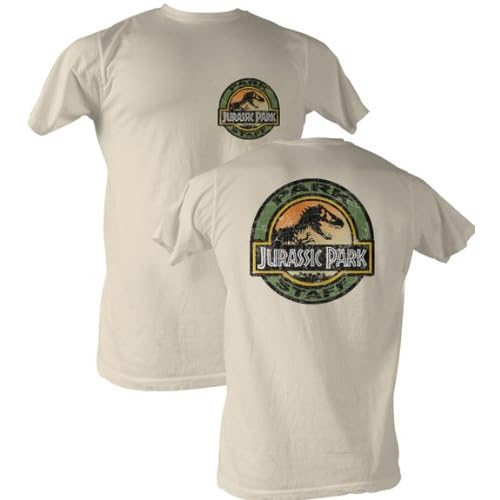
So, I found this shirt yesterday on the internet with the help of my bestest buddy, Thomas Petty, and today I decided to buy it. And why not? It's a Jurassic Park Staff T-Shirt! Now I can strut about with authorization as an authentic member of the Isla Nublar/Isla Sorna Staff. Best job ever, if you're not, you know, getting torn apart. This shirt will help me make friends in college.